A hairline crack on a Sharjah facade rarely stays a hairline crack for long. Give it one humid August and one dusty shamal season, and that crack can widen, develop stains, and allow moisture to penetrate the substrate behind it. What begins as a minor AED 200 repair can eventually turn into a AED 20,000 problem not necessarily because the building has failed, but because the early warning signs were overlooked. This is why Frontline Technical Services emphasizes timely facade inspections, preventive maintenance, and early intervention to help property owners in Sharjah avoid costly structural deterioration. It’s not simply a worst-case scenario; it’s a maintenance risk supported by building deterioration research and the challenges of Sharjah’s climate.
Why Sharjah’s Climate Runs the Deterioration Clock Faster
Most property owners budget maintenance on a calendar. Sharjah’s climate doesn’t care about calendars, it runs on humidity and salt exposure instead.
Sharjah regularly records some of the highest relative humidity readings in the UAE, with the National Center of Meteorology noting that the highest humidity in the country often occurs over northern coastal areas including Sharjah and Ras Al Khaimah, with levels climbing as high as 90% during peak humidity periods. Pair that with Gulf-facing wind patterns and industrial zones like Hamriyah and Sajaa, and you get three forces working on a facade at once.
- Moisture: near-constant condensation cycles that keep masonry and coatings damp far longer than the paint was engineered for
- Salt: airborne chloride that corrodes metal fixtures, fasteners, and rope-access anchor points faster than inland buildings ever experience
- Heat and dust: summer temperatures past 45°C that bake coatings brittle, followed by shamal winds that sandblast the surface clean of whatever protection remains
None of these forces is dramatic on its own. Combined and left unaddressed, they compound.
What Happens When Maintenance Gets Pushed Back
Facilities research has been tracking this exact pattern for decades, and the numbers are consistent regardless of climate or building type. A widely cited industry analysis found that reactive maintenance costs institutions five to ten times more per asset than maintaining those same assets on a regular schedule. Separately, maintenance researcher David Tod Geaslin’s well-known “Inverse-Square Rule” illustrates the same curve in plainer terms: a $100 component left in service until it fails can turn into a $10,000 repair once the failure cascades.
Translated to a Sharjah building, the pattern looks like this:
| Stage | What’s visible | Typical fix at this stage | Relative cost |
|---|---|---|---|
| Early | Light staining, dust film, minor efflorescence | Routine facade cleaning | 1x |
| Moderate | Paint chalking, hairline cracks, localized peeling | Surface prep + repaint | 3–4x |
| Advanced | Substrate exposure, rust streaking, coating delamination | Structural repair + full recoat | 8–10x+ |
| Neglected | Spalling, corroded fixtures, water ingress | Specialist remediation, rope-access intervention | Multiples higher, plus liability exposure |
The jump isn’t linear. It’s the gap between a cleaning crew and a structural contractor.
The Four-Stage Deterioration Pathway on Sharjah Facades
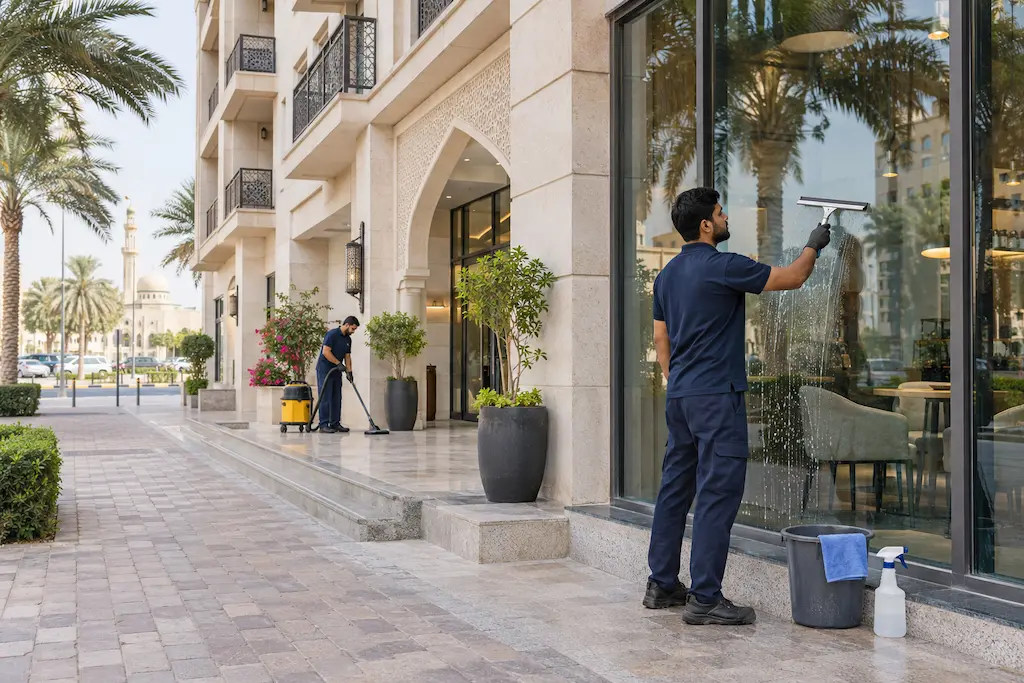
1. Surface staining and biological growth: This is the stage almost every building reaches and almost every owner ignores, because it looks cosmetic. It isn’t trapped moisture under a dirt film is what feeds the next stage. Routine facade cleaning in Sharjah resets this clock before it becomes a coatings problem.
2. Coating and paint failure: Once the protective layer chalks or peels, the substrate underneath is exposed to the same humidity and salt cycle directly. A proper repaint with painting services built for Sharjah’s conditions uses coating systems suited to this exposure, rather than a standard interior-grade product that won’t hold.
3. Corrosion acceleration from bird fouling: This stage is easy to underestimate. Bird droppings are acidic, and on ledges, parapets, and AC units they actively eat into metal and stone faster than salt air alone. Preventing roosting with bird spikes installation is one of the cheapest interventions on this whole list, relative to what it prevents.
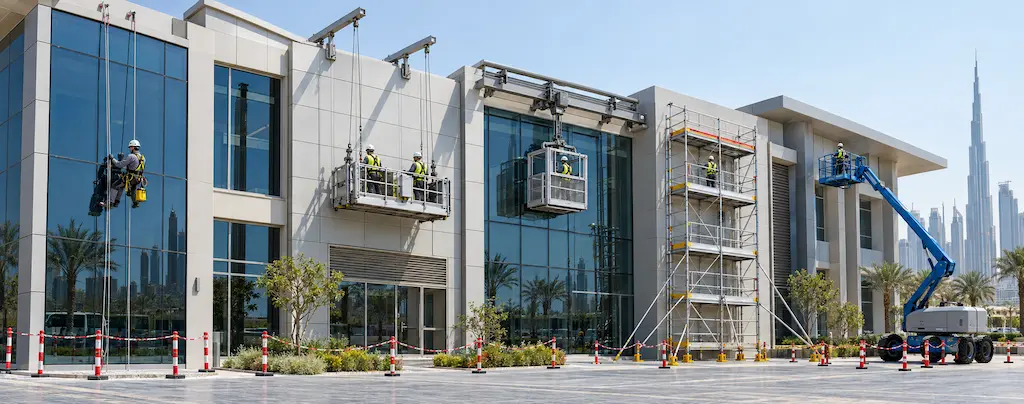
4. Structural and access-risk escalation: By this point, repairs usually require working at height and a facade that’s been neglected long enough to need structural attention is also the one where access is hardest and most dangerous. This is where rope access cleaning in Sharjah becomes a safety requirement, not a convenience.
A Research-Backed Reality Check
Climate-driven paint studies have found that the standard five-to-seven-year repainting interval, long treated as a safe default in less aggressive climates, doesn’t hold up in environments with sustained saline air exposure degradation sets in measurably faster, and repainting is needed earlier than the textbook schedule assumes.
That research was conducted outside the Gulf, but the mechanism is the same one acting on Sharjah’s coastal and industrial zones. A maintenance plan built around a generic five-to-seven-year cycle is, in practice, a deferred-maintenance plan in this climate, it just doesn’t feel like one until the paint starts going.
Building a Maintenance Rhythm That Actually Fits Sharjah
A workable schedule isn’t about doing more, it’s about matching the interval to what the climate is actually doing to the building:
- Facade cleaning on a shorter cycle for buildings near the coast or within range of industrial dust, not the generic annual default
- Coating inspections before the hot season, since that’s when existing damage accelerates fastest
- Bird-proofing installed proactively on ledges and rooftops, rather than after droppings have already pitted the metal
- Access points and anchor fixtures checked for salt corrosion before they’re needed for the next maintenance round
Conclusion
Deferred maintenance in Sharjah isn’t a single bad decision, it’s a series of reasonable-looking ones. Skipping one cleaning cycle looks harmless. Delaying a repaint by a year looks like a minor scheduling call. But in a climate running 85-90% humidity, heavy salt exposure, and summer heat past 45°C, each of those small delays compounds faster than it would almost anywhere else. The data backs this up consistently: reactive repairs cost multiples more than planned ones, and the gap widens the longer a building sits unattended.
The fix isn’t more spending, it’s earlier spending, on a schedule that matches what Sharjah’s climate is actually doing to the building, rather than a generic maintenance calendar borrowed from a milder environment. A facade caught at the staining stage costs a fraction of one caught at the corrosion or structural stage.
Frequently Asked Question
How often should a building facade be cleaned in Sharjah?
Buildings near the coast or industrial zones generally need cleaning more often than the standard annual cycle, since salt and dust accumulate faster there. A facade cleaning assessment of the specific location is the most reliable way to set the right interval.
What’s the earliest sign that maintenance is being deferred?
Light surface staining, dust film, or minor efflorescence, the stage most owners dismiss as cosmetic. Left alone, it traps moisture against the surface and feeds the next stage of deterioration.
Why does paint fail faster in Sharjah than the standard 5–7 year repaint cycle suggests?
Sustained salt-laden, humid air degrades coatings faster than drier climates, so the textbook repaint interval doesn’t hold up here. Buildings exposed to coastal or industrial air typically need repainting sooner than that default.
Are bird droppings really a maintenance risk, or just a cosmetic issue?
They’re a real risk bird droppings are acidic and actively corrode metal ledges, parapets, and AC units over time. Installing bird spikes before fouling starts is far cheaper than repairing the corrosion it causes.
When does a maintenance job require rope access instead of standard cleaning?
Once deterioration reaches the structural or substrate-exposure stage, repairs usually involve working at height on compromised surfaces which is a safety requirement, not a preference. Rope access teams are trained specifically for that condition.
Is it cheaper to bundle cleaning, painting, and bird-proofing into one maintenance plan?
Yes, treating them as one coordinated schedule closes the gaps where deferred maintenance usually starts, compared to calling each service separately only after a problem is already visible.