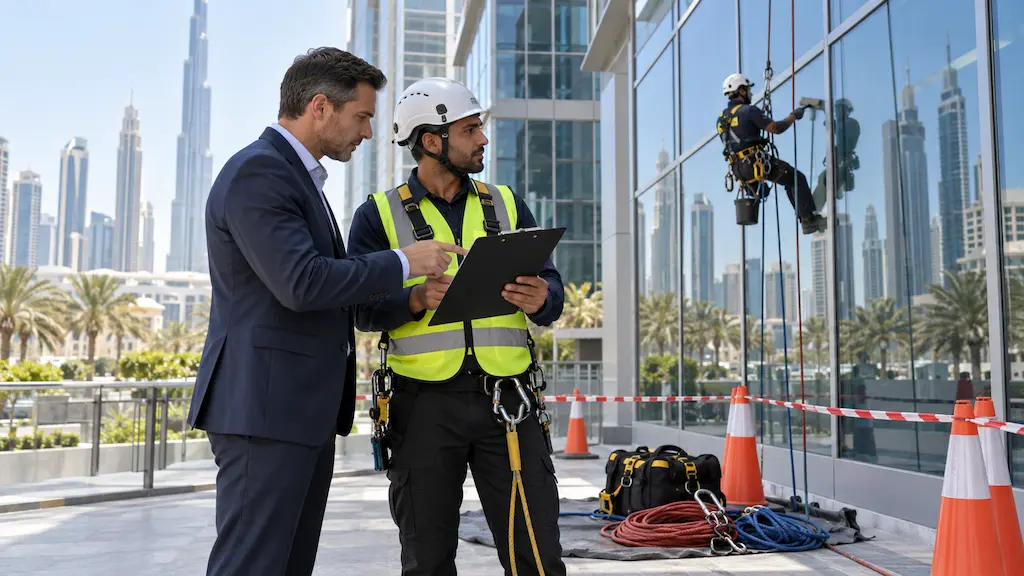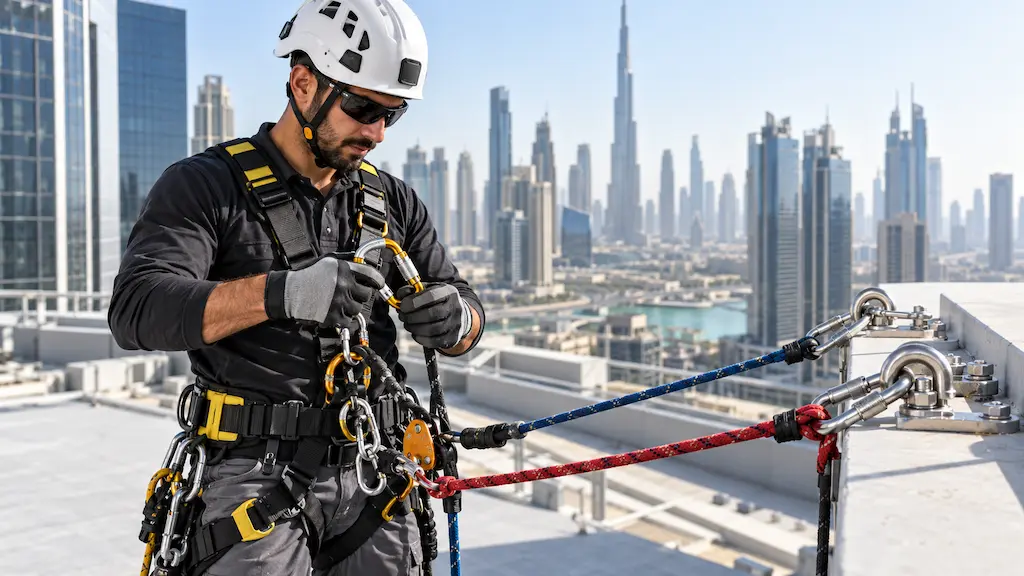
Your facade cleaning crew arrives, sets up on the roof, and then stands down without going over the edge. The building manager is told it is too windy. From the ground floor, it feels like an ordinary day.
Is that a genuine safety call or a contractor avoiding work? Almost always the former, and there is a published figure to check it against. This guide covers the wind speed limit that applies in Dubai, why ground-level conditions are misleading, the other weather that stops high-rise work, and how to plan a facade program around all of it. It’s part of how we approach every facade cleaning in Dubai and facade cleaning in Sharjah project at Frontline Technical Services.
The Limit: 25 km/h
Dubai Municipality’s technical guideline for rope access systems, DM-HSD-GU35-URAS2, is specific. All rope access activity must be reviewed or postponed if wind speed exceeds a continued 25 km/h, or where gusting and local eddies exist.
Two parts of that wording matter. Continued means sustained wind, not a single gust. A brief gust does not automatically stop work, but sustained wind above the threshold does.
Or where gusting and local eddies exist is the broader condition, and in a city of towers it is often the one that bites. Even when sustained wind sits below 25 km/h, unpredictable gusting around a building can make work unsafe and the guideline treats that as its own reason to stop.
Why That Threshold Is Lower Than It Sounds
25 km/h is not a storm. It is a breeze that moves light branches and lifts loose paper.
That feels conservative until you consider what a rope access technician is doing: suspended on two lines against a glass face, holding tools, with nothing to brace against. Wind at that speed swings a suspended person, pushes them toward the facade, and makes controlled work genuinely difficult. It also moves ropes against edges and carries dropped objects away from the exclusion zone below.
Now compare it with normal UAE conditions. The National Centre of Meteorology routinely forecasts winds of 40 to 50 km/h, with gusts raising dust and reducing visibility. In the current forecast period alone, the NCM has warned of gusts reaching 50 km/h across several days.
That is roughly double the regulatory threshold, in an ordinary week.
So weather stops are not an inconvenience that occasionally interrupts a project. In the UAE they are a normal, predictable part of facade work and any contractor who tells you their crews never stand down is telling you something concerning about how they operate.
Ground Level Tells You Nothing About the 40th Floor
This is the part building owners find most surprising.
Wind speed increases with height. Above that, tall buildings actively change airflow: they accelerate wind around corners, channel it between neighboring towers, and create downdraughts and swirling eddies that do not exist at street level. A calm podium entrance tells you nothing about conditions where the crew is working.
This is precisely why the guideline requires a calibrated anemometer on site, rather than letting a supervisor check a weather app. The forecast is a planning tool. The decision to work is made by measurement at the building, on the day.
It is also why wind monitoring must be written into the safe system of work the guideline lists arrangements for effective monitoring of wind speed as a required element, not an optional one.
The Other Conditions That Stop Work
Wind is the most quoted limit, but it is not the only one.
| Condition | Why It Stops Work |
|---|---|
| Blowing dust and low visibility | The supervisor cannot see the crew, the crew cannot see hazards, and ground teams cannot manage the exclusion zone |
| Rain | Wet facades and wet ropes change handling and grip; surfaces below become slippery for ground crew |
| Lightning | Metal anchors, wet ropes and an exposed position at height; no facade job justifies the risk |
| Extreme heat | Heat stress at height impairs judgement; UAE midday working restrictions also apply during summer months |
| Proximity to overhead lines in wind | The guideline notes strong winds can cause overhead electric lines to sway, reducing the safe clearance distance |
In the UAE, dust is the condition most likely to stop work after wind. The two usually arrive together: NCM advisories regularly pair strong gusts with blowing dust and reduced visibility. It is also the condition most likely to puzzle a client, because the wind may feel manageable while visibility has dropped below what safe supervision requires.
What a Proper Weather Stop Looks Like
A compliant stop is not a phone call saying “too windy today”. It should involve:
- A measurement, taken on site with a calibrated anemometer, not a forecast app
- A decision by the rope access supervisor, who is the competent person for that call, one reason supervisor certification matters, as we cover in our guide to rope access certification in the UAE
- Securing the site equipment made safe, ropes removed or secured, exclusion zones cleared
- A record, noting the conditions, the time and the decision
- Communication to you, with a revised plan rather than an open-ended delay
That record matters beyond the day itself. It is evidence that the decision was made properly, which is relevant if anything is ever questioned later, a point we cover in who is liable if a facade cleaning accident happens at your building.
What should concern you is a crew that works through conditions others have stood down in, has no anemometer visible on the roof, or cannot tell you what their stop threshold is.
Planning a Facade Programme Around the Weather
You cannot control the weather, but you can plan for it.
Build contingency into the schedule:
A facade program with no weather allowance will overrun. Ask your contractor what allowance they have built in, and treat a confident “none needed” as a warning sign.
Avoid the worst windows:
Wind patterns in the UAE are seasonal, and shamal conditions bring sustained strong winds and dust. Our guide to the best time to schedule facade cleaning in Dubai covers the seasonal picture.
Ask how resumption works:
Does the crew wait on site for conditions to improve, or demobilize and return? Both are legitimate; what matters is that you know which, and what it costs.
Settle the cost question in the contract:
Who bears the cost of a weather day is a contractual matter, and it should be agreed before work starts rather than argued afterwards.
Expect dust to follow wind:
A windy period often means a dusty facade shortly afterwards which is why cleaning scheduled immediately after a dust event produces a better result than cleaning just before one.
Frequently Asked Questions
What Wind Speed Stops Facade Cleaning in Dubai?
Activity must be reviewed or postponed above a continued 25 km/h, or where gusting and local eddies exist, under Dubai Municipality’s rope access guideline.
Can the Crew Work If the Forecast Says 20 km/h?
Possibly, but the forecast does not decide it. The measurement taken on site does, because conditions at height around a tower differ from the general forecast.
Who Decides Whether to Stop?
The rope access supervisor on site, the competent person responsible for that work. It is not a decision for the building owner or the project manager.
Is Dust Really a Reason to Stop?
Yes. If the supervisor cannot maintain visual contact with the crew, or ground teams cannot manage the exclusion zone, the work cannot be supervised safely regardless of wind speed.
Do Cradle and Scaffold Systems Have the Same Limits?
They have their own manufacturer and regulatory limits, which differ from rope access. Suspended platforms are particularly affected by wind. Confirm the specific limits for whichever access method is being used on your building.
Can We Agree to Work Through It If We Accept the Risk?
No. The requirements are safety requirements, not contractual preferences, and the contractor’s duty to its technicians is not something a client can waive. A contractor willing to accept such an instruction is one to avoid.
How Much Delay Should I Expect?
It depends on season and building, which is why the question to ask is what allowance your contractor has built into the programme rather than what the exact number will be.