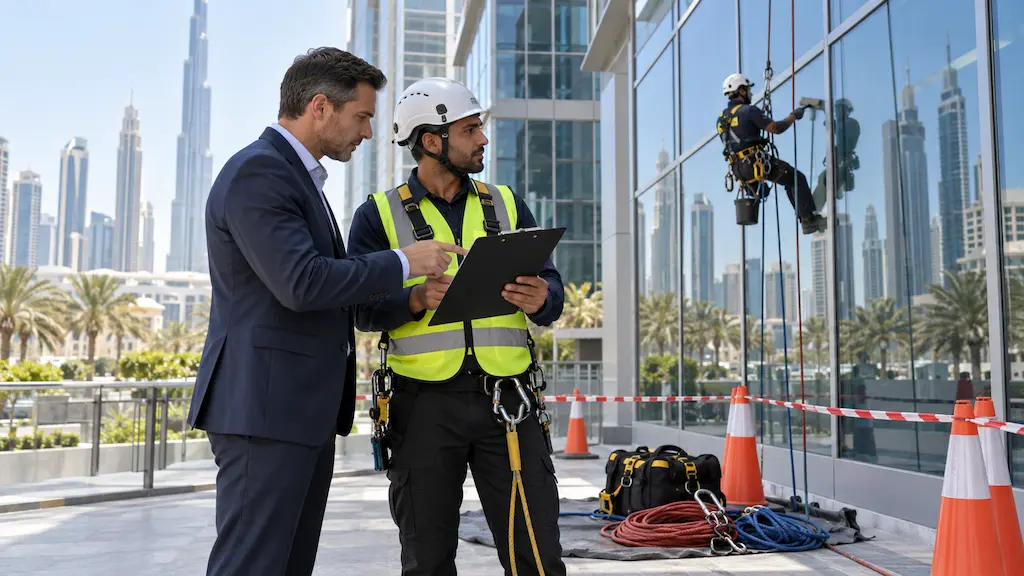
A crew arrives at your tower at seven in the morning. By half past, two men are over the parapet on ropes, forty floors up. Somebody on your side signed that contract, and if something goes wrong at eleven o’clock, the questions will come to the building, not only to the contractor.
Most building owners never see the paperwork behind that moment. They compare three quotes, pick one, and assume the company knows what it is doing.
The reassuring part is that you do not have to take it on trust. Dubai Municipality publishes the technical guideline that governs rope access work, it is public, and it tells you exactly what to ask for. At Frontline Technical Services we work to that standard every day, and this guide sets out what it actually requires, so you can check any contractor against it, including us.
The document that governs this work
The operative reference in Dubai is Technical Guideline DM-HSD-GU35-URAS2, Usage of Rope Access System, issued by Dubai Municipality’s Health and Safety Department. The current version is 2.1, dated 11 January 2021.
It applies to all establishments using rope access systems in the Emirate of Dubai which includes you as the building owner, not only the contractor. The guideline is explicit that it exists to support owners, managers and employees alike.
It sits alongside UAE Federal Law No. 8 of 1980 and Dubai Municipality Local Orders 61 of 1991 and 11/2001, which require employers to provide a safe place of work.
What follows is what that guideline requires, in the order it matters to you.
1. The company and its people must be EIAC certified
The guideline states that rope access operations should only be undertaken by specialist and EIAC certified companies and personnel. EIAC is the Emirates International Accreditation Centre.
For individuals, the requirement is a valid EIAC-accredited third-party certification, the guideline gives IRATA Level 1 or 2 as the example for technicians, and IRATA Level 3 for supervisors.
The distinction matters. A training certificate from an unaccredited provider is not the same thing. Ask to see the certification and who accredited it.
2. Three roles, not one crew
The guideline does not treat a rope access team as interchangeable workers. It defines three distinct roles, each with its own requirements.
| Role | What the guideline requires |
|---|---|
| Rope Access Manager (Appointed Person) | Appointed by the company. Practical experience of various work methods. Creates method statements, selects working methods, ensures supervision and equipment are appropriate, monitors effectiveness |
| Rope Access Supervisor | Valid EIAC-accredited third-party certification, e.g. IRATA Level 3. Competent in rescue techniques. Valid first aid at work certification. Must not suffer from acrophobia. Every work site must be properly and adequately supervised |
| Rope Access Technician | At least 18 years old, normally maximum 100 kg. Valid EIAC-accredited certification, e.g. IRATA Level 1 or 2. Regular medical examination for physical fitness |
The technician requirements go further than most owners expect. The guideline lists medical conditions that generally rule a person out of work at height, including heart disease, high blood pressure, epilepsy, vertigo, impaired limb function and diabetes, and requires regular medical examination.
What to ask: who is the appointed Rope Access Manager for this contract, and will a certified supervisor be on site for the full duration?
3. Equipment must be third-party certified every six months
This is the requirement contractors most often fall short on, and it is easy for you to check.
The guideline requires that permanent anchorages, chemical resin or mechanical anchor bolts be thoroughly inspected and certified by an EIAC-accredited third-party company on initial installation, after any modification, and at least once every six months.
The same six-monthly third-party certification applies to all other elements of the rope access system: harnesses, karabiners, slings and the rest.
Separately, a competent person must visually inspect the system before each use, and the guideline recommends buddy checking between team members throughout the day.
Equipment with any defect, damage or deterioration must be removed from service, and so must anything past the manufacturer’s stated shelf life. Unauthorised repairs are prohibited.
What to ask: for the current third-party inspection certificates, dated within the last six months. If the contractor uses subcontracted technicians, the guideline requires the main company to confirm the subcontractor meets these same inspection requirements.
4. Two ropes, two anchors and anchors that were never meant to hold anyone
The guideline requires the rope access system to be securely attached to at least two independently anchored systems, with each anchor point of sufficient strength for any foreseeable loading. It cites BS 8610, BS EN 795 and the IRATA requirement of a minimum 15 kN.
The technician must be connected to both the working line and the safety line through a full body harness, even when a work seat is used.
The rope itself is specified: kernmantle construction, semi-static low-stretch type, between 10.5 mm and 11.5 mm diameter, to EN 1891. Dynamic mountaineering rope to EN 892 is explicitly not suitable for suspension or as a back-up rope. The back-up device must meet EN 12841 Type A or equivalent.
The guideline also names things that must never be used as anchors:
- TV antennas
- Metal chimneys
- Small pipes and ducts
- Roof vents or hatches
- Stair or balcony railings
- Fixed access ladders
If you go up to your own roof and see ropes tied to any of those, stop the work.
5. A rescue plan for your building specifically
A generic safety policy is not what the guideline asks for, It requires a specific rescue plan for each worksite, with on-site practice where appropriate, and rescue equipment appropriate to that workplace. Technicians must be able to recover themselves or be recovered quickly by the work team or a dedicated on-site rescue team.
The guideline sets out a hierarchy of four rescue options, beginning with lowering a suspended person and ending with rescuing another during descent. It also requires periodic emergency drills and an adequate number of first aiders and fire wardens.
This matters because suspension trauma is time-critical. Waiting for Civil Defence is not a rescue plan.
What to ask: for the rescue plan written for your building, naming who performs the rescue and with what equipment.
6. Wind must be measured, not judged
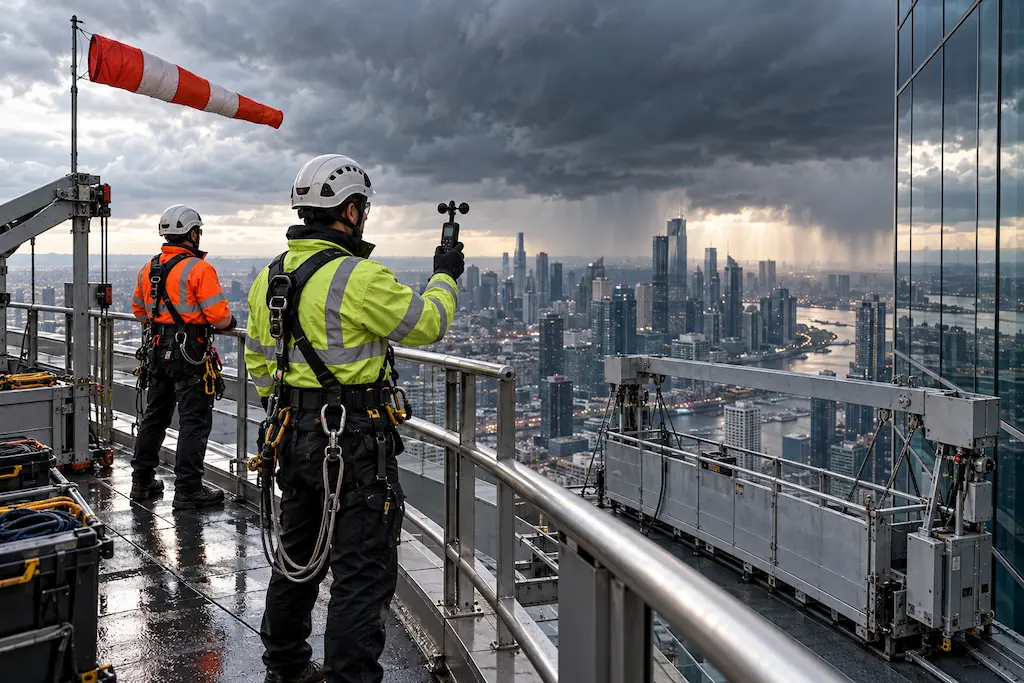
The guideline requires a calibrated anemometer on site, and states that all rope access activity must be reviewed or postponed if wind speed exceeds a continued 25 km/h, or where gusting and local eddies exist.
That last part matters on tall buildings in Dubai. Wind at street level tells you very little about conditions at the fortieth floor, and towers create their own eddies between them.
A crew that decides by feel is not meeting the standard. A crew that packs up at 25 km/h is.
7. Tools, exclusion zones and the people below
The guideline is specific about dropped objects. All items must be attached to prevent falling, and large items over 8 kg must be suspended on an additional haul rope. Exclusion zones must be established as appropriate, and not only at the top and bottom of the drop.
There are also electrical requirements: minimum safe distances from overhead lines per DEWA guidance, all lines treated as live until declared dead, and an electrical work permit from a competent person or authority before work near energised equipment.
The documents you are entitled to ask for
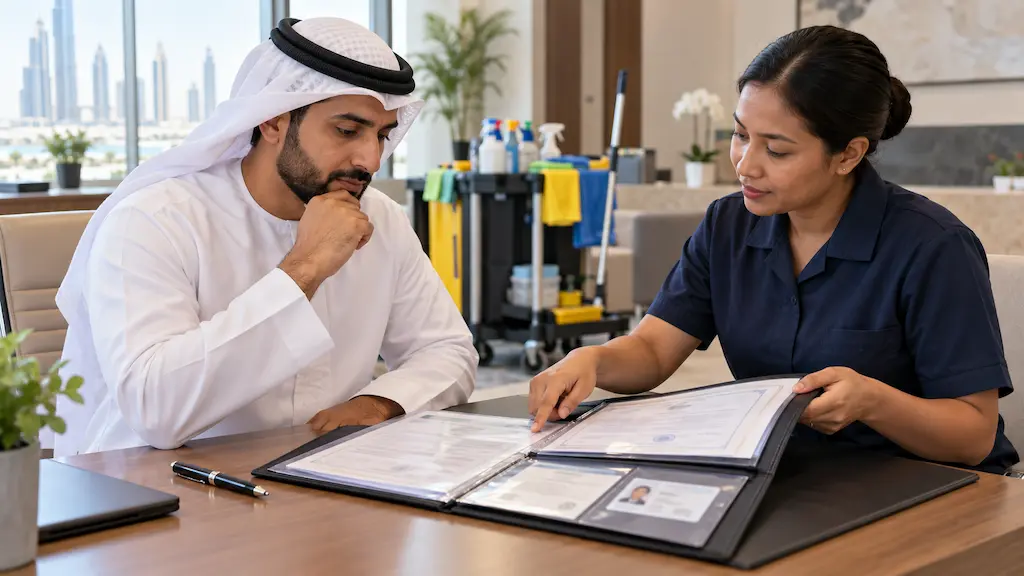
Before signing, request all of these. A compliant contractor will have them ready.
- Valid trade licence covering the relevant cleaning activity
- EIAC-accredited certification for the company
- EIAC-accredited third-party certification for each technician and supervisor on your job
- Name of the appointed Rope Access Manager
- Supervisor’s valid first aid at work certificate
- Third-party anchorage inspection certificates, dated within six months
- Third-party certification for harnesses, karabiners and slings, dated within six months
- Written risk assessment for your building
- Safety method statement for the work
- Site-specific rescue plan
- Public liability and workmen’s compensation insurance certificates
The guideline requires training records to be kept for at least five years and all inspection and testing documents to be made available to Dubai Municipality OHS inspectors on request. If the contractor cannot produce them for you, they could not produce them for an inspector either.
Red flags to watch for on site
- Ropes anchored to railings, vents, pipework or antennas
- A technician on a single rope rather than a working line and a safety line
- No anemometer anywhere on the roof
- Tools and buckets not attached, or heavy items carried rather than on a haul rope
- No supervisor present, or a supervisor who is also on the ropes all day
- No barriered exclusion zone at ground level
- Equipment with no inspection tags or traceable markings
- Crews working through visibly gusting conditions
Any one of these is worth a conversation. Several together mean the work should stop.
What about Sharjah?
GU35 applies, by its own scope, to establishments in the Emirate of Dubai. Buildings in Sharjah fall under Sharjah’s own municipal requirements, and owners there should confirm the current position with Sharjah Municipality rather than assume the Dubai guideline applies.
In practice, the underlying safety principles accredited certification, twin ropes, independently certified anchors, a site-specific rescue plan are international, and come from the same standards the Dubai guideline references. A contractor working properly in Dubai is working properly in Sharjah. The regulatory paperwork is simply not automatically transferable, so ask for it either way.
Our facade cleaning in Sharjah teams work to the same requirements set out above, and the same document checklist applies. If you manage a building in Sharjah, ask for exactly the same certificates and inspection dates you would ask for in Dubai.
Frequently asked questions
Is IRATA certification legally required in Dubai?
The Dubai Municipality guideline requires valid EIAC-accredited third-party certification and gives IRATA levels as its examples. The accreditation is the requirement; IRATA is the most commonly recognised route to it.
Who is liable if a technician is injured on my building?
This depends on the contract, the insurance in place and the circumstances, so take your own legal advice. What you can control is appointing a contractor who meets the published standard and keeping copies of the documents above.
How often should anchor points be inspected?
At least once every six months by an EIAC-accredited third party, plus on installation and after any modification. A competent person must also check the system before each use.
Can a contractor use my building’s existing anchor points?
Only if they have been verified as having adequate capacity and carry current third-party certification. Many older Dubai buildings have anchors that have never been recertified.
Is rope access safer than a cradle or scaffold?
The guideline requires the safest appropriate method to be chosen for the specific job after a risk assessment not a default. It explicitly says alternatives such as cleaning from inside, suspended access equipment or mobile platforms may be credible options. We compare the methods in our guide to why rope access is better than scaffolding.
What should I do if I think a crew is working unsafely on my building?
Stop the work and raise it with the contractor’s appointed manager. Dubai Municipality’s Health and Safety Department can be reached on 800900. In an emergency, call 998 or 999.
Before you appoint anyone
The standard is public, specific and checkable. You do not need technical knowledge to use it you need the list above and a contractor willing to hand over the paperwork.
Frontline Technical Services has worked on Dubai and Sharjah buildings for over 20 years, and our rope access cleaning in Dubai and facade cleaning in Dubai teams work to the requirements set out above. If you are reviewing quotes, we are happy to walk through our certification and method statements with you before you decide and to tell you what to look for in the other two quotes on your desk.