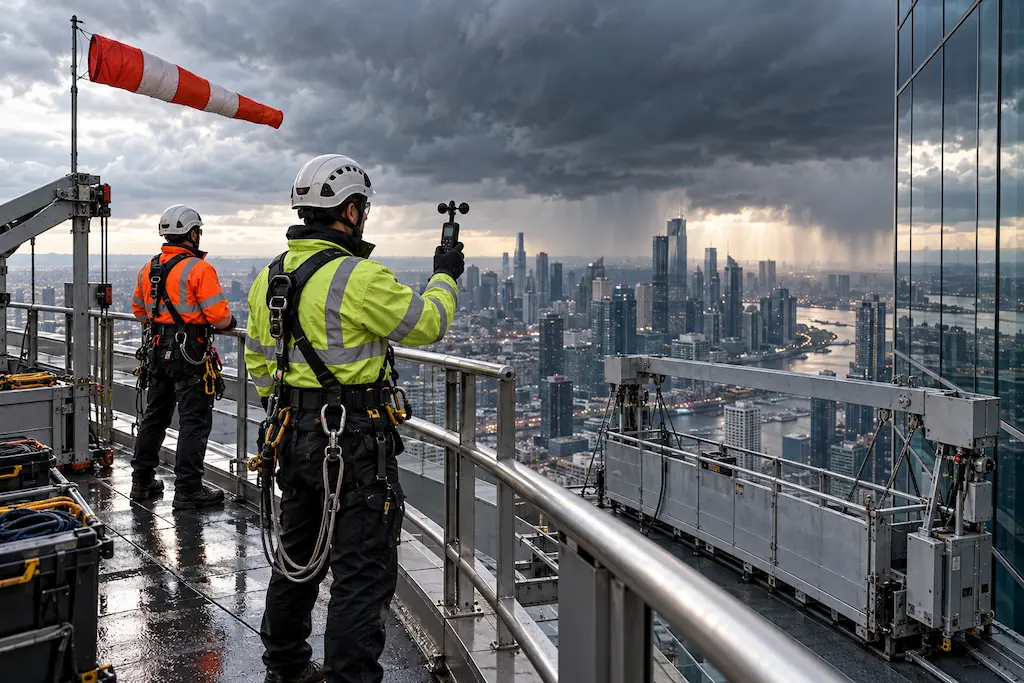
A technician is injured working on your tower. Within hours there are questions from the contractor, from insurers, possibly from the authorities and somewhere in that sequence, someone asks what the building did to satisfy itself that the crew was competent.
That is usually the moment a building owner discovers whether their paperwork is in order. This guide explains what determines liability when a facade cleaning accident happens in the UAE, which insurance covers what, and most usefully what you can do before any contractor goes over the parapet to limit your exposure. At Frontline Technical Services we are asked this regularly by facility managers, and the honest answer deserves more than a reassuring sentence.
This article is general information, not legal advice. Liability depends on your specific contract, the facts of the incident, the insurance in place and how a court or authority assesses them. If an incident has occurred, or you are reviewing a contract, take advice from a UAE-qualified lawyer.
Rope Access Accident Liability in the UAE: The Honest Answer for Building Owners
There is no fixed rule that says “the contractor is always liable” or “the building owner is never liable”. Liability is determined by a combination of things:
- Who employed the injured person, and what duties that employer owed
- What your contract says about responsibility, indemnities and insurance
- What actually happened, equipment failure, procedural failure, or something on the building’s side such as a defective anchor point
- What insurance exists, and whether the incident falls within it
- Whether reasonable care was taken in selecting the contractor
That last one is where building owners are most often exposed, and it is also the one entirely within your control.
Where the Employer’s Duty Sits
The technician on the ropes is employed by the cleaning contractor, and UAE law places clear safety duties on employers.
The current legislation is Federal Decree-Law No. 33 of 2021 on the regulation of employment relations, which came into force on 2 February 2022. Article 13 requires employers to provide a safe and suitable working environment. Where a worker suffers a work injury, the employer carries obligations toward them, and work injuries must be reported to the Ministry of Human Resources and Emiratisation (MoHRE), generally within 48 hours.
A note worth knowing. Dubai Municipality’s rope access guideline, DM-HSD-GU35-URAS2, was issued in January 2021 and cites Federal Law No. 8 of 1980 as the source of that duty. That law was repealed thirteen months later.
The guideline’s technical requirements certification, anchor inspection, rescue planning all still stand, and the employer’s duty still exists. It simply now sits in the 2021 Decree-Law instead. If a contractor quotes the 1980 law at you, they are reading an old reference rather than the current one.
Where the Building Owner’s Exposure Sits
You are not the technician’s employer. That does not place you outside the picture.
As the party in control of the premises: The building is yours. If an accident involved something on your side, a corroded or uncertified anchor point, an unsafe roof access route, a hazard you knew about that is a question directed at the building, not the contractor.
Through your contract: Contracts allocate risk. Indemnities, insurance requirements and liability provisions determine who carries what. A contract that says little on these points does not protect you; it leaves the position to be argued afterwards.
Through how you chose the contractor: This is the part most owners overlook. If you appointed a contractor without checking certification, insurance or method statements, you may be asked to explain that decision. “They were the cheapest quote” is a difficult answer.
This is why the documentation covered in our guide to facade cleaning safety and compliance in the UAE matters beyond safety. Those documents are also the record of your own due diligence.
The Insurance Map:
This is the section most worth reading twice, because the distinction is routinely misunderstood.
| Policy | What it generally covers | What it does not cover |
|---|---|---|
| Workmen’s compensation / employer’s liability | Injury or death of the contractor’s own employees | Third parties; property damage |
| Public / third-party liability | Injury to third parties and damage to third-party property including your building | The contractor’s own employees |
| Property insurance (yours) | Damage to your building, subject to policy terms | Injury to anyone |
The critical point: a contractor who shows you a public liability certificate has shown you nothing about cover for their own technicians. Those are two different policies.
If a technician is injured, the policy that responds is workmen’s compensation. If a dropped tool damages a car in your car park, it is public liability. Ask for both certificates, check the dates, and check the limits are sensible for a high-rise.
Also worth asking: whether cover extends to subcontracted technicians. Many rope access crews include subcontractors, and cover does not always follow them automatically.
What Protects You, in Practice:
In rough order of value:
- A written contract that states who is responsible for what, which insurances are required, and at what limits.
- Copies of both insurance certificates, in date, before work starts not promised, held.
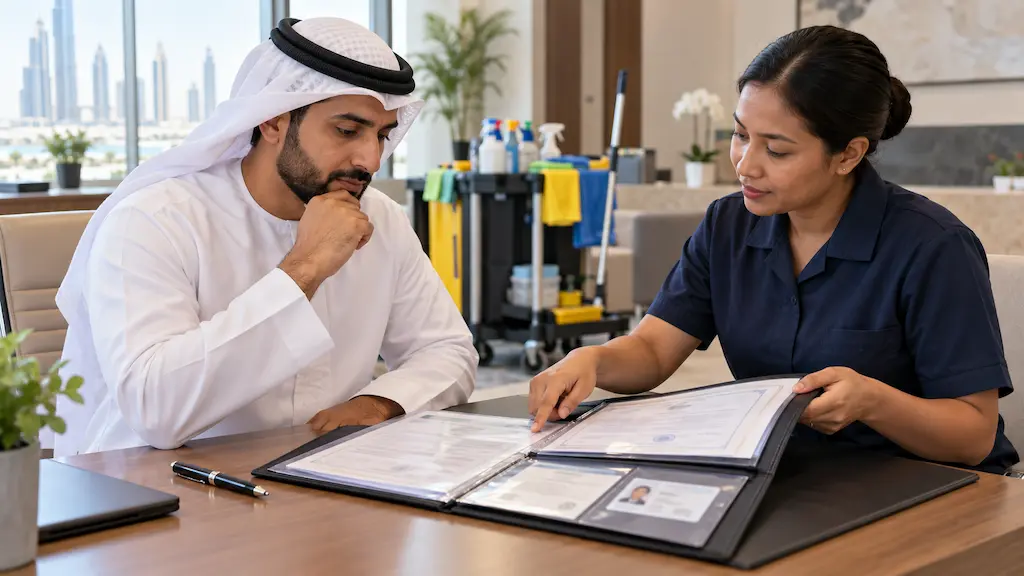
- Certification records for the named technicians on your job, with levels and expiry dates.
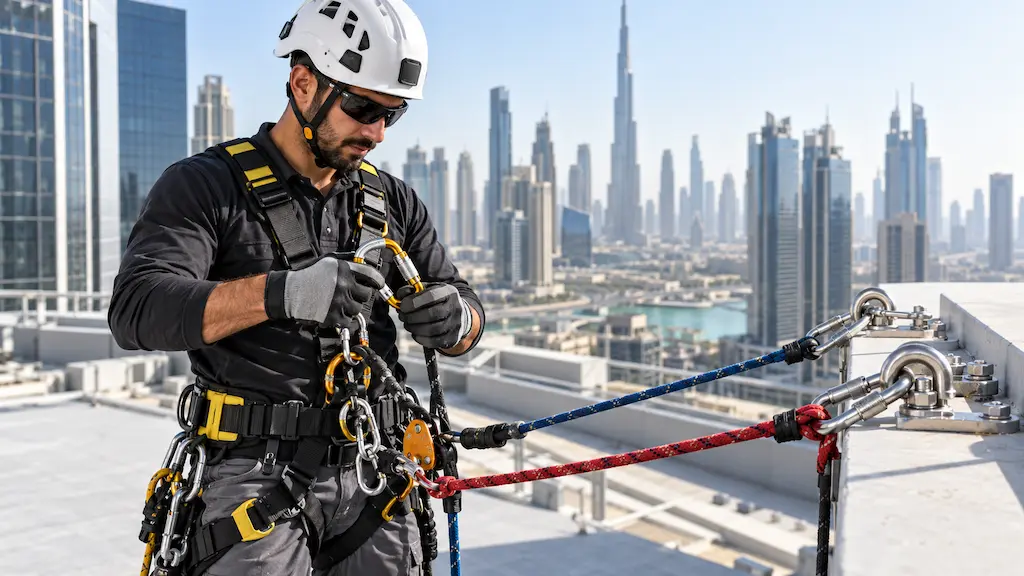
- Current third-party inspection certificates for anchors and equipment. Dubai Municipality’s guideline requires anchorages and rope access equipment to be inspected and certified by an EIAC-accredited third party at least every six months.
- A written risk assessment and method statement specific to your building.
- A site-specific rescue plan.
- Your own anchor-point certification, if the building has permanent anchors. These are part of the building, not the contractor’s kit, and owners are often surprised to find theirs have never been recertified.
- A record of your selection process the quotes compared, the documents requested, the checks made.
That last item costs nothing and is the clearest evidence that you took reasonable care.
If an Incident Does Happen:
Get medical help first. Ambulance is 998, police 999.
Then, in roughly this order:
- Stop all work on site
- Secure the area and prevent further access
- Do not move or alter equipment beyond what is needed for safety — it is evidence
- Notify the contractor’s appointed manager immediately
- Notify your insurer and your owners’ association or managing agent
- Take photographs and written notes while the detail is fresh
- Preserve your documentation contract, certificates, method statements, correspondence
- Take legal advice before signing or agreeing anything
The contractor has their own reporting obligations, including to MoHRE. That does not replace your own record-keeping.
A Note For Owners’ Associations and Managing Agents
If you are appointing on behalf of an owners’ association, the exposure sits differently again, you may be acting as agent, with the association as principal, and the committee may have its own duties.
Two practical points. First, make sure the authority to appoint is documented, so no individual is personally exposed by a decision taken informally. Second, keep the certification and insurance records with the association’s documents rather than in one person’s inbox, because committees change and the records need to outlast them.
Frequently Asked Questions
If the contractor’s technician is injured, can the building be held responsible?
It depends on the cause and the contract. Where the accident relates to something on the building’s side, a defective anchor point, for instance, the building’s position is different from a case of purely contractor-side failure. This is exactly the situation to take legal advice on.
Does a contractor’s insurance certificate protect me?
Only to the extent of what the policy covers, for the period it covers, up to its limits. Check that you have both relevant policies, that they are current, and that limits are appropriate. An expired certificate protects nobody.
Can liability be written entirely out of a contract?
UAE law places limits on how far liability can be excluded by agreement, and the enforceability of such clauses is a legal question. Do not assume a clause in a contractor’s standard terms does what it appears to.
Who is responsible for the building’s permanent anchor points?
They are part of your building. The guideline requires them to be inspected and certified by an EIAC-accredited third party at least every six months and on installation or modification. Many older Dubai buildings have anchors that have never been recertified worth checking before anyone uses them.
Does it make a difference if I hired a cheaper, uncertified contractor?
It may well be relevant to how your own conduct is viewed. Choosing a contractor without checking certification and insurance is hard to present as reasonable care.
What about buildings in Sharjah?
The Dubai Municipality guideline applies to the Emirate of Dubai. Sharjah has its own municipal requirements, which should be confirmed locally. Our rope access cleaning in Sharjah teams carry the same certification and insurance documentation either way.
The Straightforward Version
You cannot control how an accident happens. You can control whether, on the day someone asks, you can produce a contract, two current insurance certificates, certification records for the named crew, in-date anchor inspections and a method statement for your building.
Contractors who have those documents hand them over without hesitation. That willingness is itself useful information.
If you are reviewing quotes for facade cleaning in Dubai or rope access cleaning in Dubai, we will provide our full documentation before you decide, and tell you what to ask the other contractors for.