A property manager overseeing a mixed-use building in Al Qasimia recently had to replace a cleaning contractor mid-contract not because the price was wrong, but because the company couldn’t produce proof of insurance when an incident happened on site. It’s the kind of gap that only shows up after something goes wrong, which is exactly why the selection process matters more than most managers initially think.
Quick answer: Property managers in Sharjah typically evaluate commercial cleaning contractors on licensing and insurance, experience with similar buildings, written scope of work, verifiable references, trained staff, equipment quality, service range, and response times in roughly that order of priority.
| Factor | Why it matters |
|---|---|
| Licensing & insurance | Protects the building if something goes wrong on site |
| Experience with similar buildings | A villa cleaner isn’t necessarily equipped for a high-rise |
| Written scope & pricing | Prevents disputes over what’s actually included |
| References | Past performance on similar properties is the best predictor |
1. Licensing and Insurance
This is the first thing to confirm, not the last. A contractor should be able to produce a certificate of insurance naming your building, along with general liability and workers’ compensation coverage without this in writing, any damage or injury on site becomes the property’s problem, not the contractor’s. Frontline Technical Services treats this as a baseline requirement before any site visit is even scheduled.
2. Experience With Similar Building Types
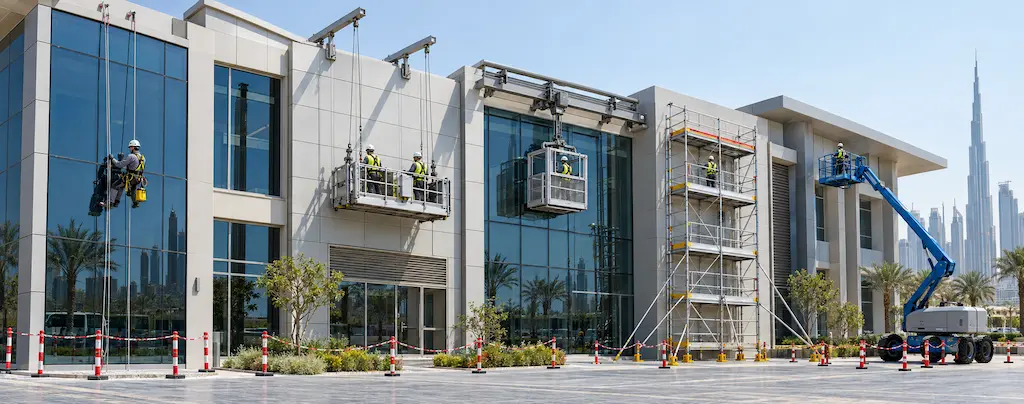
A contractor comfortable cleaning villas isn’t automatically equipped for a high-rise commercial tower, and a team built for office interiors may have no rope access or IRATA certification for exterior facade work. It’s worth asking directly: how many buildings of this type, height, and use case has this contractor actually serviced? Certification is becoming a real differentiator in the market, as covered in Sharjah Building Cleaning Industry 2026.
3. Written Scope of Work and Transparent Pricing
Vague proposals cause more disputes than high prices do. A proper scope should spell out exactly what’s cleaned, how often, and what counts as an add-on versus what’s included in the base contract. Property managers who skip this step often find out the hard way, mid-contract, when “cleaning” turns out to mean something narrower than they assumed.
4. Verifiable References
Reviews on a website are easy to curate. A stronger approach is contacting property managers at two or three buildings the contractor currently services and asking directly about consistency, responsiveness to complaints, and whether the contractor still shows up the same way six months into the contract as they did in month one.
5. Trained, Vetted Staff
Equipment and chemicals matter, but the people using them matter more. Ask whether staff are background-checked, trained on the specific equipment your building requires (rope access, water-fed poles, or standard interior cleaning), and supervised on-site rather than left to work unmonitored on a large property.
6. Equipment and Chemical Quality
Sharjah’s industrial zones and dust load mean standard equipment often underperforms. Contractors working across these conditions need equipment and detergents suited to that exposure specifically not a generic residential-grade kit stretched to cover commercial-scale dirt and particulates.
7. Service Range
A contractor who can only handle one service say, interior cleaning but not facade or glass work forces a property manager to coordinate multiple vendors, multiple invoices, and multiple access schedules for what should be one maintenance relationship. A single contractor covering building cleaning, facade cleaning in Sharjah, and related maintenance under one contract is usually the more efficient path, provided they can actually deliver on all of it rather than subcontracting pieces out.
8. Response Times and Service Guarantees
Some of the strongest contracts specify exact response windows for urgent issues spills, safety hazards, or compliance-related cleaning, rather than a vague “we’ll get to it.” Ask what the contractor’s actual commitment is in writing, not just what they say verbally during the sales conversation.
Why This Decision Carries More Weight Than It Looks
Choosing the wrong contractor isn’t just an inconvenience, it has a real cost over time, as shown in The Cost of Deferred Building Maintenance in Sharjah, which is exactly why these eight factors matter more at the selection stage than they seem to at first.
Conclusion
The right commercial cleaning contractor in Sharjah isn’t necessarily the cheapest one, it’s the one who can prove, in writing, that they’re actually equipped for your specific building. Insurance, experience, a real scope of work, and references that check out are worth more than a polished sales pitch, and checking all eight factors upfront costs far less time than discovering a gap mid-contract.
Frequently Asked Questions
How many quotes should a property manager get before choosing a cleaning contractor?
Two or three is generally enough to compare pricing, scope, and responsiveness without the process dragging on indefinitely.
Is it worth paying more for a contractor with broader service range?
Often, yes consolidating cleaning, facade, and related maintenance under one contractor reduces coordination overhead, even if the per-service rate looks slightly higher than hiring separate specialists.
What’s the biggest red flag when evaluating a contractor?
Inability to produce proof of insurance or a written scope of work on request, both are easy for a legitimate contractor to provide immediately.
How often should a commercial cleaning contract be reviewed or re-tendered?
Most property managers reassess annually, even with a satisfactory contractor, it keeps pricing competitive and gives a natural checkpoint to confirm insurance, staffing, and service quality haven’t quietly slipped.
Should a property manager choose the lowest bid among qualified contractors?
Not automatically. Once insurance, experience, and references check out, the lowest bid among otherwise-qualified contractors is a reasonable tiebreaker, but a low bid that skips those checks usually means something’s being cut to hit the price.